
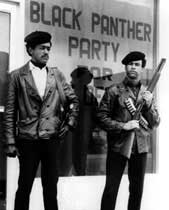
In the late 1960s a group of black militants burst onto the scene to capture the hearts and minds of inner city youth with fiery rhetoric and words as slick as their black leather jackets. Through armed police brutality patrols and calls for "power to the people", the Black Panther Party embodied the radicalization of the Black Struggle and inspired a generation of young people to become politically active. The Party however, was not just a Self-Defense organization. Early on, founders Huey Newton and Bobby Seale, articulated their immediate demands and political positions into a ten point program. In the autobiography of Bobby Seale, Seize the Time, explains the importance of the ten point program.
Huey said, "We need a program. We have to have a program for the people. A program that relates to the people. A program that the people can understand. A program that the people can read and see, and which expresses their desires and needs at the same time. It's got to relate to the philosophical meaning of where in the world we are going, but the philosophical meaning will also have to relate to something specific."
Point 10 on the Panther's ten point program proclaimed, "We want land, bread, housing, education, clothing, justice and peace." However, as Marxists, the Panthers recognized that their interests conflicted with the interests of the bourgeoisie. Newton states, "The Black Panther Party is a revolutionary Nationalist group and we see a major contradiction between capitalism and our interests". So, just how would these demands be met? Newton goes on by saying, "We realize this country became very rich upon slavery and that capitalism is slavery in the extreme. We have two evils to fight, capitalism and racism.We must destroy racism and capitalism." Their interests therefore, could only be realized through the destruction of capitalism through a socialist revolution.
Participatory Planning
In a post-revolutionary society the means of production are owned by everyone in equal share and not by one particular production group. The bourgeoisie and petite bourgeoisie will no longer have a monopoly on the decision making process. Each actor in society would influence decisions in proportion in which they are affected by them. Society will thus be participatory and egalitarian.
Participatory planning allows participants to exercise direct democracy and allows ordinary citizens to control their own lives. Citizens of a post-revolutionary society will be organized into federations of workers and consumer councils. Workers in worker councils need to articulate proposals on what and how much they want to produce, as well as the resources needed for production. Consumers, on the other hand, will need to express through proposals what and how much they intend to consume. Both production and consumption proposals will be sent to the facilitation board where through a system of proposals, amendments, and rejections, a social plan articulated to cover the entire economy is hashed out.
Personal Consumption Proposals
How can demands for "land, bread, housing, education, clothing,justice and peace" be achieved in a socialist society? The answer to this question lies in participatory planning.
For example, Omar, an African-American living with his girlfriend in a co-housing community in Detroit, Michigan, is working on his personal consumption proposal. His neighborhood already negotiated it's collective proposals, which have consequently, been summed up with county, state, regional and national collective consumption proposals.
Omar, like most able bodied individuals, works at a roughly average job complex and requests a roughly average consumption bundle. He knows that everyone has a finite share of the total social product. So all citizens can request things up to the limit of their budget allocated to them. Logging on to his computer, he begins to draft a consumption proposal based on combinations of different goods he desires and their indicative prices.
Omar is unfortunately a very picky eater, so his choice of foods are very limited. He bases his food consumption proposal on his old grocery store lists in pre-revolutionary and capitalist days. His computer program manipulates the input to articulate it for the whole year. Of course, he may change his mind, so fortunately for him, the iteration processes of participatory economics introduces "slack" in the social plan to allow for spontaneous "purchases". Omar is really a simple man and doesn't need a roomful of clothes, so he is modest when it comes to his clothing requests. A dozen or so new shirts and pants, a trench coat, boots for the winter, more socks( they continue to disappear in drying machine post-revolution too!), and other items will do him fine.
Even though, Omar enjoys living in the co-housing community, he and is girlfriend decided they wanted a bit more privacy and want to relocate into a household in Kalamazoo, Michigan. The Housing Facilitation Board is a group of workers that assists people wishing to change their residence. Likewise, the Employment Facilitation Board is a group of workers whom assists people who wish to change their workplace. These two boards help Omar and his girlfriend relocate to an available household in Kalamazoo, as well, as get him quickly situated in a new workplace.
One of the other main reasons, why Omar wanted to move to Kalamazoo, was because it houses a brand new college specifically centered on African And African American Studies. Before the revolution, such places didn't exist and it was senseless to major in African studies at a college because that degree was useless on the job market . Now, part of his job complex is teaching Egyptian History in a local community Center, as well as smelter in a local steel plant.
In capitalism, Omar was subject to police brutality and racial profiling. Being born in a poor neighborhood in Detroit, he had little chance to pursue higher education or escape the vicious circle of poverty. His mother lived off of paycheck to paycheck and some nights all he had to eat was his hatred for being born black and poor.
However, after the socialist revolution, Omar has more opportunities and more freedoms than ever before. All basic necessities such as food, shelter, clothing, medical care, etc are easily met now. There is no more police brutality, black on black crime has gone down from the Crips and Gangster Disciples having been disbanded, he has enrolled in college which is provided free to all citizens and he goes to bed each night with his hunger satisfied.
In conclusion, post-revolutionary society will be participatory and egalitarian. The social plan for society will be reached upon by a series of proposals from workers' and consumers' (neighborhood) councils and meetings of regional delegates. This makes sure that every citizen's demand for "land, bread, housing, education, clothing,justice and peace" is met and that the Panther legacy continues to live on.
Cheers
-blackstone


 |
The Northeastern Federation of Anarchist- Communists recently met for our annual international conference. We met in a wonderful meeting space provided by Encuentro 5 in Boston and spent two days evaluating how best
to continue the movement towards libertarian-communism and workers power.
In attendance were comrades from Montreal, DC/Maryland, Boston, New York City, New Jersey, Pittsburgh, Philadelphia, and Western Mass. First we went around the room and reported back on what projects collectives and
individual supporters/members had been involved with since our last
meeting. Activities were broad and included the organization of speaking events and book fairs, active participation in labor, community and student organizing, and militant action against fascists.
We next discussed the state of NEFAC's printed publications The
Northeastern Anarchist and Ruptures, our two theoretical magazines, and Cause Commune a free anarchist newspaper. Discussion was given to how best to allocate funds to publications and other methods of distribution of propaganda including blogs and pdfs that could be printed locally and distribute at a low cost.
Discussion was then given over to new collectives that wished to gain supporter or member status. A new DC/Maryland supporter collective was accepted and the Antithesis collective of NYC became a member collective. Both decisions came after a careful evaluation of the work that the collectives were doing and planned to do, and their political awareness. We are pleased to welcome both collectives into NEFAC.
We reflected on a discussion document brought to us by a New York member, concerning anti-imperialism and 'national liberation' movements. No
conclusions were reached, but there is a feeling that we are beginning to develop a shared vocabulary with which to approach these important questions. We then discussed the state of the anti war movement and how best to continue our efforts to halt the current wars.
The second day was largely dedicated to a lively discussion on how NEFAC can best continue and improve our work while dealing with some of the difficulties inherent with being a federation divided by the US/Canadian border. A discussion document with many ideas towards this end was brought to the conference by Canadian comrades and provided the framework
for our discussion. The discussion and the process goes on, and we are fully confident that it will result in a stronger anarchist communist presence in the north east.
In addition we discussed the proposal by our comrades in the Workers Solidarity Alliance to participate in a meeting of various groups interested in broadly red and black politics, Details are still being discussed but we are enthusiastic about this opportunity to further communication and cooperation amongst the class struggle anarchists.
With best wishes and solidarity to the working class, and unrelenting hostility to the bosses!
For more info about NEFAC, click here


