Saying goodbye to black actors who died in 2007
By: Jackie Jones
They were civil rights pioneers, entertainers, writers, sports legends and journalists. Some broke new ground; others brought us art, beauty and comfort. Some provoked discussions in homes, bars and barbershops across the country and still others brought us the real story behind the inner workings of government and industry.
This is a look back at the lives and the accomplishments of some of those black Americans lost this year:
Darrent Williams of the Denver Broncos was killed in a drive-by shooting just hours into the New Year after leaving a nightclub in Denver. Williams, a second-round pick in the 2005 draft out of Oklahoma State, started nine games as a rookie due to injuries. This season, he took over as the starter for Lenny Walls alongside Champ Bailey and was second on the team with four interceptions and tied for third with 86 tackles.
---
Gerald "Wash" Washington, 57, the first black mayor-elect of Westlake, a largely white Louisiana town was found dead in a parking lot on Jan. 2 just three days before he was to take office. Local authorities initially ruled the death a suicide, but state police opened an investigation following lingering questions about Washington’s mysterious death.
---
Jane Bolin, whose appointment as a family court judge by New York City Mayor Fiorello H. LaGuardia in 1939 made her the first black woman in the United States to become a judge, died on Jan. 8 in Queens, N.Y. She was 98. The Poughkeepsie-born Bolin was also the first black woman to graduate from Yale University Law School, the first to join the New York City Bar Association and the first to work in the city's legal department. Bolin said her law career was inspired in part by images of lynching she had seen in the media. "It is easy to imagine how a young, protected child who sees portrayals of brutality is forever scarred and becomes determined to contribute in her own small way to social justice," she wrote in 1978.
Look into your financial future. Are you on track?
---
Alice Coltrane, the jazz pianist and organist who was closely linked with the music of her late husband, legendary saxophonist John Coltrane, died Jan. 14. She was known for her contributions to jazz and early New Age music, including bringing the harp into jazz music and featuring astral compositions, as well as being the keeper of her husband’s archive and musical legacy. A convert to Hinduism, Coltrane was also a significant spiritual leader and founded the Vedantic Center, a spiritual commune in the Los Angeles area.
---
Pookie Hudson, 72, lead singer and songwriter for the doo wop group The Spaniels, who lent his romantic tenor to hits like "Goodnight, Sweetheart, Goodnight" and influenced generations of later artists, died Jan. 16. Hudson wrote "Goodnight, Sweetheart, Goodnight" ("well, it's time to go") for a young woman he was dating at the time. "He was staying awful late at the young lady's house and her parents said ... he had to go. As he was walking home, that's what inspired him to write that song," said longtime manager Wellington "Bay" Robinson. The Spaniels' signature song was a Top 5 R&B hit in 1954. The McGuire Sisters rushed out a version of it that sold even more copies. At the time, only black radio stations played Hudson's version. The Spaniels' version was finally heard two decades later on the soundtrack of "American Graffiti." Among the Spaniels' other Top 20 R&B hits, were "Baby, It's You," "Peace of Mind" and "Let's Make Up."
---
Billy Henderson, 67, a member of the band The Spinners, whose voice was heard most prominently on "I'll Be Around," died on Feb. 2.
Also on that date, Joe Hunter, Motown’s first bandleader and a three-time Grammy winner with the Funk Brothers, died. He was the first person hired in the late 1950s by Berry Gordy Jr. and he went on to hire many of the backup musicians who formulated the Motown sound and ultimately became known as the Funk Brothers. Hunter’s piano work was a major ingredient in the songs “Heat Wave” and “Pride and Joy.” After a 2002 documentary, “Standing in the Shadows of Motown,” was released, the soundtrack won two Grammys, and in 2004, the Funk Brothers were given a Lifetime Achievement Award.
---
Singer-actress Barbara McNair, 72, who gained fame as a nightclub singer and Broadway star in the ‘60s, died on Feb. 4. After strong reviews in a musical called “The Body Beautiful” in 1958, McNair starred in the Broadway musical “No Strings” in 1963. She hosted her own TV variety show from 1969 to 1971 and starred with Sidney Poitier in the 1970 films “They Call Me Mister Tibbs” and “The Organization” in 1971.
---
Olympic medalist Willye White, 67, a two-time Olympic medalist in track and field and the first woman to compete for the United States in five Olympics, died Feb. 6. White competed in five consecutive Olympic Games between 1956 and 1972. She won a silver medal in the long jump at the 1956 Games in Melbourne, Australia, at age 16 and won her second silver medal in 1964 as a member of the 4x100-meter relay team in Tokyo.
---
Thomas Stockett, 82, a illustrator and political cartoonist for the Afro-American Newspaper, died Feb. 21. Stockett started drawing at the age of four and began painting as a teenager. He worked for a local sign shop where he designed movie billboards for various theaters in Baltimore before joining the Afro-American Newspapers in 1955 as the political cartoonist. "He was an institution that surpassed his position as just being an illustrator for the Afro-American Newspaper," said Afro Publisher Jake Oliver about Stockett. "His cartoons and illustrations had the power to make readers laugh, cry, be angry, but most of all, think."
---
Dennis Johnson, 52, a five-time All-Star and star defensive guard who was part of three NBA championships, died Feb. 22. He played on title teams with the Boston Celtics in 1984 and 1986 and the Seattle SuperSonics in 1979, a series in which he won the finals MVP title. Johnson was coach of the Austin Toros of the NBA Development League.
---
Lamar Lundy, 71, was a member of the famed Fearsome Foursome defensive line for the Los Angeles Rams in the 1960s. The 6-foot-7 Lundy, who died Feb. 24, was the first black player to receive a football scholarship at Purdue. With the Rams, he, along with Roosevelt Grier and Hall of Famers Deacon Jones and Merlin Olsen, formed the Fearsome Foursome, who were noted for stopping running backs and harassing quarterbacks, despite having only one winning season from 1963 to 1966, when the linemen played as a unit.
---
Damien Nash, 24, was a running back for the Denver Broncos, died Feb 24. The fifth-round draft choice by Tennesee in 2005 played in just three games for the Titans. The Broncos signed him as a free agent last season. He played in three games, rushing for 66 yards on 18 carries. In his two-year career, he had 24 carries for 98 yards and seven receptions for 55 yards.
---
Ronnie Wells, a popular jazz vocalist based in Washington, D.C. who came to prominence in the mid-1960s, making several television appearances and singing on stage with a number of luminaries, including Billy Eckstine, Lonnie Liston Smith and Oscar Brown, Jr., died March 7. She appeared semi-annually for five years, beginning in 1992, at Blackbeard’s Castle in St. Thomas, U.S. Virgin Islands, and also performed on a number of occasions with the U.S. Airmen of Note, the U.S. Navy Commodores Orchestra and appeared at the Kennedy Center, Smithsonian Institution and other concert halls nightclubs and jazz festivals in the U.S. and abroad. She also had taught jazz vocal techniques in a program she created at the University of Maryland’s Department of Music.
---
Luther Ingram, 69, the R&B singer and songwriter best known for the hit "If Loving You Is Wrong (I Don't Want to Be Right)," died on March 19. Ingram performed with Ike Turner at clubs in East St. Louis, roomed with Jimi Hendrix in New York and was the opening act for Isaac Hayes. He recorded through the 1980s and performed in concert until the mid-1990s, when his health began declining.
---
G.E. Patterson, 87, the presiding bishop of the Church of God in Christ and a minister for almost 50 years, died March 30. In January, he won the traditional male vocalist of the year honor for his "Singing the Old-Time Way Volume 2" at the 22nd annual Stellar Gospel Music Awards.
---
Born Bert Cooper in Nassau on Oct. 18, 1934, Calvin Lockhart moved to New York at age 18. After a year at the Cooper Union School of Engineering, he dropped out to pursue a career in acting. His on-screen heyday in the 1970s included prominent roles as the smooth-talking preacher/con artist in "Cotton Comes to Harlem" and an underworld character in "Uptown Saturday Night." Described by a New York Times writer in 1970 as having "matinee idol looks," with "chiseled-out-of-marble features" and "skin the color of brown velvet," Lockhart, who died March 29, had his first starring film role that year in "Halls of Anger," a racially explosive drama in which he played an ex-basketball star and English teacher who becomes vice principal of an inner-city high school where 60 white students are being bused in. About nine years ago, Lockhart moved back to the Bahamas, where he worked as a director on several productions of the Freeport Players Guild.
---
The legendary former Grambling State University football coach Eddie Robinson, 88, sent more than 200 players to the NFL, including Hall of Famers Charlie Joiner, Buck Buchanan, Willie Davis and Willie Brown. Robinson, who died April 3, won 408 games in 45 winning seasons, nine National Black College championships and 17 Southwestern Athletic Conference titles during a 57-year career. Robinson’s tenure spanned 11 presidents, several wars and the civil rights movement.
---
Darryl Stingley, 55, a quadriplegic who became a symbol of the violence of football, was playing for the New England Patriots as a wide receiver when he was hit and permanently injured by Oakland Raiders defensive back Jack Tatum during a preseason game on Aug. 12, 1978. He died April 5.
---
Actor Roscoe Lee Browne, 81, was known for his rich voice and dignified bearing, which brought him an Emmy Award and a Tony nomination, died April 11. Browne's career included classic theater and TV cartoons. He also was a poet and a former world-class athlete. His deep, cultured voice was heard narrating the 1995 hit movie, "Babe."
---
At age 15, June Johnson, a founding member of the Student Non-Violent Coordinating Committee, was beaten and jailed in Mississippi during a voter registration training course. On the road on June 11, 1963, as part of the training course, the SNCC volunteers’ bus stopped at whites only lunch counter and one of their party tried to use the segregated restroom. Separated from the group at the local jail, Johnson was beaten and when she tried to take a shower to clean up, she was scalded. After her release, the FBI followed Johnson to a camp up north and tried to get her to sign a statement saying her injuries were a result of infighting among her fellow civil rights workers. She was a plaintiff and paralegal investigator in lawsuits to stop racist practices in government and schools in two Mississippi counties and worked with Robert Kenney and Marian Wright Edelman to draw attention to the failure of the state’s anti-poverty efforts. She died April 13.
---
Jazzman Andrew Hill, 75, a groundbreaking pianist and composer known for his complex post-bop style, died April 20. According to Cem Kurosman of Blue Note Records, Hill released his final album, "Time Lines," in early 2006, a farewell that earned him album of the year honors from Down Beat magazine. He performed up until about three weeks before his death with his trio at a Manhattan church. Hill was widely lauded within the jazz community; Blue Note founder Alfred Lion once described him as "the next Thelonious Monk." But he was often overlooked by mainstream audiences, which focused on contemporaries like Miles Davis and Charlie Parker. Hill had performed with both while a young man.
---
Rep. Juanita Millender-McDonald, 68 (D-Calif.), was a seventh-term congresswoman from a heavily Democratic Southern California district that includes Compton, Long Beach and parts of Los Angeles. When the Democrats took over after the 2006 midterm elections, Millender-McDonald became chair of the Committee on House Administration, which oversees operations of the House and federal election procedures. She also worked on issues including election reform and opposing the genocide in Darfur. She died April 22.
---
Clarinetist Alvin Batiste toured with Ray Charles and Cannonball Adderley, recorded with Branford Marsalis and taught pianist Henry Butler. Though his age was not precisely known, New Orleans Jazz & Heritage Festival officials said he was born in New Orleans in 1932. Batiste suffered a heart attack and died May 6, just hours before he was to perform at the festival with Marsalis and Harry Connick, Jr.
---
Diego "Chico" Corrales, 29, won boxing titles in two weight classes and was involved in one of the most memorable fights in recent times. Corrales was a big puncher best known for getting up after two 10th-round knockdowns to stop Jose Luis Castillo on May 7, 2005. He died on that same date two years later.
---
Yolanda Denise King, 51, the Rev. Martin Luther King Jr.'s eldest child, pursued her father's dream of racial harmony through drama and motivational speaking. King, who died May 15, appeared in a number of films, including a role as civil rights martyr Medgar Evers’ daughter in "Ghosts of Mississippi," and as Rosa Parks in the 1978 television miniseries "King." King also ran a film production company. King, who was 12 when her father was slain, learned of his death from a television news bulletin while washing dishes at her family’s home in Atlanta.
---
Actor Carl Wright, 75, began his career as a tap dancer and comedian and later appeared in movies including "Barbershop" and "Big Momma's House." His film credits also included "Soul Food," "Barbershop 2: Back in Business" and "The Cookout." He died May 19.
---
New England Patriots defensive end Marquise Hill, 24, spent much of his free time and his NFL paycheck helping loved ones in New Orleans rebuild in the hurricane-damaged city where he grew up.The former LSU star died in a jet ski accident on Lake Pontchartrain on May 27.
---
Parren J. Mitchell, 85, a Baltimore civil rights activist who became Maryland's first black member of Congress in 1970, died on May 28. A former head of the Congressional Black Caucus and chairman of the House Small Business Committee, Mitchell worked for years to assure minority participation in contracts let under federal public works programs. After earning his undergraduate degree from Morgan State University in 1950, Mitchell was denied admission to graduate school at the University of Maryland in College Park. He sued and won, becoming the first black graduate student at College Park, receiving a master’s degree in sociology in 1952.
---
Rhythm-and-blues singer Bill Pinkney, 81, the last survivor of the original members of the musical group The Drifters, died July 4. Pinkney was among the seven significant contributors to The Drifters inducted into the Rock and Roll Hall of Fame, including original members Clyde McPhatter and Gerhardt Thrasher, and subsequent members Ben E. King. Charlie Thomas, Rudy Lewis and Johnny Moore.
---
Robert "Buck" Brown, 71, one of the first "crossover" African-American cartoonists, whose work appeared in Playboy magazine over four decades, died July 7. Playboy printed more than 600 of Brown's cartoons, including one that appeared in the magazine's August issue. His daughter, Tracy Hill, told the Associated Press that Brown sold thousands more to other publications. Brown's work also appeared in Ebony, Jet, the New Yorker, Esquire and the Chicago Sun-Times.
---
Charles Tisdale, 80, owner and publisher of the Jackson (Miss.) Advocate and a civil rights activist, was credited with giving voice to black Americans in Jackson and throughout the state of Mississippi. Tisdale, who died July 7, continued to publish even after 84 bullets were fired into his then-office on East Hamilton Street in Jackson. Two former Ku Klux Klansmen were convicted in 1982. The office was firebombed at least twice, including in 1998 when gasoline was poured over the furniture and Molotov cocktails thrown through the window, according to the Associated Press. A Jackson man later pleaded guilty to the crime.
---
Harold “Mr. Butch” Madison Jr., a homeless man, was something of an icon in Boston’s Kenmore Square before moving to Harvard Avenue in nearby Allston a decade ago. Ranting in rhyme with a beer in hand, Madison was known to panhandle one minute and offer to share his take with a friend the next. After his death on July 11, friends organized a city parade in his honor.
---
Eddie Pinder, 36, a producer at ABC News described as “a large man with a personality to match,” died July 12. He was noted for his a body of work that included a “Master Teacher” series for the network’s "Nightline," on the experiences of a first-year public school teacher dealing with at-risk fourth-graders in Brooklyn, N.Y.; a story on linguistic profiling for 20/20, and the “America in Black & White” series for Nightline, telling the story of a man who discovers for the first time that he is the son of an African-American."
---
Chauncey Bailey, 57, reporter and editor for the Oakland Post, was noted for his stories chronicling the history and the challenges facing the black community. Police said Bailey was gunned down August 2 by a man who told them he was angry over stories the journalist had written as part of an investigation into the financial activities of the Your Black Muslim Bakery in Oakland, Calif. Dozens of reporters, photographers and editors formed The Bailey Project, a coalition to continue Bailey’s work. It is the largest group journalistic investigation in more than 30 years. It is patterned after The Arizona Project, which was formed in 1976 following the slaying of Arizona Republic investigative reporter Don Bolles, who was killed by a bomb placed under his car while he was investigating links between Phoenix businessmen and organized crime.
---
Asa Hilliard, 73, scholar, professor at Georgia State University, was heralded as a pioneer who helped elevate the study of classical African culture and for working to eliminate racial bias in the American educational system. He died Aug. 12 while leading a tour of students in Egypt. Before joining Georgia State, Hilliard spent 18 years at San Francisco State University where he was a department chairman and, later, dean of education. He also a consultant to the Peace Corps and was a school psychologist and superintendent of schools in Monrovia, Liberia, for six years. He was also a member of the National Black Child Development Institute and the Association for Study of Classical African Civilization.
---
Max Roach, 83, a master percussionist whose rhythmic innovations and improvisations defined bebop jazz during a wide-ranging career where he collaborated with artists from Duke Ellington to rapper Fab Five Freddy, died Aug. 15.
---
Many a woman swooned listening to jazz balladeer Jon Lucien, who died Aug. 18. Known for his romantic baritone voice, Lucien also was considered a forerunner of fusion, influenced by calypso, jazz, bossa nova, soul and R&B.
---
Eddie Griffin, former Seton Hall and Houston Rockets star, was killed Aug. 21 when his sport utility vehicle collided with a freight train in a fiery crash. Investigators used dental records to identify Griffin, 25, who began his tumultuous pro career with the Houston Rockets in 2001. He was waived by the Timberwolves in March.
---
Basil O. Phillips, 77, a longtime photo editor at Ebony and Jet magazines, headed a staff that cataloged and managed more than 1 million photographs, drawings, and color transparencies in the world's largest collection on the black experience in America. He died Aug. 27.
---
Percy Rodrigues’ role as a neurosurgeon in the 1960s television series "Peyton Place" broke ground because he was cast as an authority figure when relatively few black actors were given such parts. When Rodrigues was added to the "Peyton Place" cast in 1968 as Dr. Harry Miles, the headline in The New York Times read, "A Doctor's Role for Negro Actor." Rodrigues, 89, who died Sept. 6, also had a long career as a voice actor. About the same time as his breakthrough on "Peyton Place," Rodrigues, a Canadian of African and Portuguese descent, played a commodore in a Star Trek TV episode and an embittered doctor in the 1968 film, "The Heart Is a Lonely Hunter." From the 1950s through the 1980s, he acted in more than 80 film and television productions, including the 1979 miniseries "Roots: The Next Generation."
---
Hercules L. Joyner, 89, the father of "Tom Joyner Morning Show" host Tom Joyner and entrepreneur Albert Joyner, died Oct. 21 in his Dallas home. Known for his dry wit and gentle ways, "Pops," as he was affectionately called by family and friends, graduated from Florida A&M College with bachelor of science in chemistry. While at Florida A&M, Joyner pledged with the Omega Psi Phi Fraternity and became an avid golfer. In later years, "The Herc" Golf Tournament was named after him. To share his passion for black colleges, Joyner was an active member of the Tom Joyner Foundation, created by his son 10 years ago to help keep students enrolled in historically black colleges and universities.
---
Donda West, 58, mother of rapper Kanye West, was the former chairwoman of Chicago State University's English department and was the inspiration for the song, "Hey Mama," on Kanye West's 2005 album, "Late Registration." In May, she published the book, "Raising Kanye: Life Lessons from the Mother of a Hip-Hop Star," in which she paid homage to her famous son. She died Nov. 10.
---
Ian Smith, 88, was the steely prime minister of Rhodesia -- now Zimbabwe -- who unilaterally declared the former British colony's independence in 1965 and spent 14 years defying international sanctions and calls for black majority rule. He died Nov. 20.
---
Washington Redskins safety Sean Taylor, 24, died on Nov. 27, a day after he was shot at home during a botched burglary at his Florida home. An All-American at the University of Miami, Taylor was drafted by the Redskins as the fifth overall selection in 2004.
---
Rapper Pimp C, 33, who helped define Southern hip-hop with his group, UGK, died Dec. 4. Pimp C, whose real name was Chad Butler, formed UGK with his partner, Bun B, in the late 1980s in Port Arthur, Texas. The group's first nationally distributed album, "Too Hard to Swallow," was released in 1992. The next year, a song from the album was included on the soundtrack for the film, "Menace II Society."
---
Ike Turner’s role as one of rock's critical architects was overshadowed by his ogrelike image as the man who abused former wife and icon Tina Turner. Turner, 76, managed to rehabilitate his image somewhat in his later years, touring with his band, the Kings of Rhythm, and drawing critical acclaim for his work. Turner died Dec. 12. He won a Grammy in 2007 in the traditional blues album category for "Risin' With the Blues."
---
Often called the father of distance running and the “pioneer of ultramarathoning,” Ted Corbitt, 88, competed in the marathon in the 1952 Olympics, introduced ultramarathon races to the United States, organized a number of running groups, developed accurate methods of measuring long-distance races and helped design the course for the inaugural course for the New York City marathon in 1970. One of the few elite black athletes in distance running, Corbitt’s time of 2 hours, 44 minutes and 15 seconds at the age of 51 was seven minutes faster than his Olympic time. He died Dec. 12.
---
St. Clair Bourne, 64, one of the country’s most prominent black documentary filmmakers, died Dec. 14. His works included films about Paul Robeson, Gordon Parks, Amiri Baraka and John Henrik Clarke, films for television, education, industrial and fictional films. Bourne operated his own production company, Chamba Mediaworks, Inc., and newsletter and Web site, Chambanotes.com, which served the black cinematography community.
---
Frank Morgan, 73, a jazz saxophonist whom critics likened to Charlie Parker, but whose fame was diminished by a three-decade struggle with drug addiction, died Dec. 14. He debuted as a solo artist in 1955 with a hard bop collection before slipping into addiction. He played off and on, but after a prison conversion to Islam, Morgan produced his second album in 1985 and in 1986 played a series of acclaimed performances at the Village Vanguard in New York, maintaining a rigorous schedule of performances even after he suffered a stroke in 1998. He was the lead instrumentalist on more than a dozen albums, playing with noted musicians including Wynton Marsalis, McCoy Tyner, Kenny Burrell and singer Abbey Lincoln.
---
Rep. Julia Carson, 69, the second African-American and first woman to represent Indiana in Congress, died Dec. 15. In 1997, the building that houses the government offices for Marion County’s Center Township was officially renamed the Julia M. Carson Government Center in her honor. Carson also led Congress to pass a measure awarding Rosa Parks the Congressional Gold Medal and co-sponsored a bill to remove bureaucratic bottlenecks on child health insurance. Carson worked closely with the NAACP to develop critical civil rights legislation and served as vanguard against the retrenchment of NAACP legislative priorities.
---
Hilda H.M. Mason, 91, a veteran of the civil rights movement and a member of the D.C. Council in Washington from 1977 to 1998, who dubbed herself “grandmother of the world.” A nonstop campaigner, she was virtually unbeatable at the polls as a staunch member of the D.C. Statehood Party and enjoyed broad support because of her efforts to improve literacy, education, housing and the quality of life for seniors. Mason died Dec. 16.
---
During a career that lasted six decades, Oscar Peterson, 82, became one of the most-recorded jazz pianists. Peterson, who won eight Grammy Awards, including one in 1997 for lifetime achievement, recorded more than 200 albums and was hailed as a jazz virtuoso. Even after a stroke in 1993 left him without the full use of his left hand, Peterson continued a schedule of international club and concert dates. He died Dec. 23.
---
Tom Morgan, 56, former president for the National Association of Black Journalists (NABJ), served the organization for several terms as treasurer before becoming president. He expanded the organization’s mentorship and training programs and established relationships with outside organizations like the Poynter Institute, a journalism think tank. His administration also created the Ethel Payne Fellowship for black journalists to travel to Africa for several weeks of research. He also served on the programming committee for the first Unity convention in 1994, an event that brought together the four racial minority journalists associations for a joint conference, which is now held every four years during national election years and attracts the major presidential candidates. Morgan died on Dec. 24.
Monday, December 31, 2007
Saying Goodbye to the Black Icons Who Passed in '07

Thursday, December 27, 2007
Centrally Planned vs Participatory Planned Economies
Participatory planning allows participants to exercise direct democracy and allows ordinary citizens to control their own lives. Citizens of a post-revolutionary society will be organized into federations of workers and consumer councils. Workers in worker councils need to articulate proposals on what and how much they want to produce, as well as the resources needed for production. Consumers, on the other hand, will need to express through proposals what and how much they intend to consume. Both production and consumption proposals will be sent to the facilitation board where through a system of proposals, amendments, and rejections, a social plan articulated to cover the entire economy is hashed out.
Let's be like Frank Lucas in American Gangster and cut out all the middle men.
The institutions of a participatory economy embody the values of efficiency and effectiveness that we seek. The institutions of a centrally planned economy however, no matter how valiant our efforts, no matter how beautiful are rhetoric, negate and hamper the realization of these values to take form.
Let's take a look at how central planning can be inefficient and ineffective. All which can be viewed in the history of China and Russia's usage of it.
But, first we must realize that a nation's(or regions') economy is an integrated affair. Therefore, any decisions about production in one industry will have ripple effects elsewhere. This is due to the simple fact that the output of one industry can serve as an input towards another , and thereby makes one industry dependent on another. This integration of industries can be represented through the usage of an input-output matrix.
| Industry | Metal | Coal |
| Metal | 0 | .4 tons |
| Coal | 2 tons | 0 |
Suppose through a democratic and participatory process of proposals, requests, rejections, and amendments, a social plan articulated to cover the entire economy is hashed out. One in which it articulates the need for the Coal industry to produce a net output of 200,000 tons of coal and the Metal industry to produce a net output of 50,000 tons. Suppose, coal is required to produce metal and some amount of metal in the form of tools is required to produce coal. To produce 50,000 tons of Metal requires 2(50,000)=100,000 tons of coal. Likewise the production of 200,000 tons of coal requires (0.4)(200,000)=80,000 tons of metal.
Your factory makes cars. There is a demand nationally for the cars you produce. This is known due to the fact of people putting in requests for cars through participatory consumption planning. Yet, we know that the requests and the production of cars has ripple effects. There is a finite amount of resources available to us to produce cars, as well as other products that rely on the same resources. However many cars we make, we can't use the steel and other material for other products. This also extends to human resources as well. The people assembling the cars won't be available to do other work.
There's a finite amount of resources, that goes for labor, time, natural resources, etc. What we had in Russia and China was resources being over committed. Central planners were committing more resources than were available, so there were persistent shortages. And these shortages weren't prone to one industry, but because an economy is integrated it affected other production units.
But that can be avoided with participatory planning and the elimination of the roles of central planners. People express their priorities through the usage of workers and consumer councils, and federations of these. This prevents overproduction and potentially useful products being wasted. Participatory planning is the more efficient in gauging the priorities and needs of the people, than central planning could.
Moreover, the government(centrally planned) established fixed prices for all inputs and outputs based on the role of the product in the plan and on other noneconomic criteria. The prices did not reflect the supply and demand or relative scarcity of the product. Shortages occurred and prices were established too low which resulted in allocation inefficiency and ineffectiveness. So, what we had was some outputs being cheaper than the inputs used to produce it! For example, bread was cheaper than the wheat needed for its production!
Yet, that can be avoided with participatory planning and the elimination of the roles of central planners. People express their priorities through the usage of workers and consumer councils, and federations of these. This prevents inefficient allocation and goods being over or undervalued which can cause scarcity or overproduction. Participatory planning is the more efficient in gauging the priorities and needs of the people, than central planning could.
In central planned economies, managers were rewarded for meeting assigned goals. Can you see the problem here? In Russia and China, managers manipulated and lied about reaching production goals in order not to be reprimanded and to live the good petite-bourgeois lifestyle. But, remember, economies are integrated. Looking at the input output table i have above, if managers in the coal industry are lying about reaching their output goals or manipulating data, this effects the steel industry, who uses that input to produce steel. This decreases the steel intended target, which affects bike makers, car makers and all other industries that use steel as an input.
Not very efficient or effective, huh?
But that can be avoided with participatory planning and the elimination of the roles of central planners. People express their priorities through the usage of workers and consumer councils, and federations of these. Worker's self-manage these work units, information is democratized the decision making process is democratized with each actor influencing decisions in proportion in which they are affected by them.This prevents inefficient allocation and goods being over or undervalued which can cause scarcity or overproduction by managers manipulating data. It would be more beneficial to the workers of the work unit and society as a whole to report accurate data. Again, participatory planning is the more efficient in gauging the priorities and needs of the people, than central planning ever could.
Cheers
blackstone
Saturday, December 22, 2007
Africanist Movement condemns police violence and murders in Kono
 African workers mining in Kono are poor despite the millions in diamonds they bring out of the mines.
 BY CHERNOH ALPHA M. BAH, DIRECTOR OF THE AFRICANIST MOVEMENT
KONO, Sierra Leone — The Africanist Movement hereby expresses dismay over the fatal incident that culminated in the police shootings of innocent and defenseless masses in Kono struggling to take control of their resources that are being constantly looted by mercenary companies.
The Africanist Movement wishes to state that the protest of the people of Kono against the destructive and exploitative mining activities of mercenary corporations like Koidu Holdings and Branch Energy represents a critical component of the struggle for self-determination in Sierra Leone. It is a manifestation of the growing desires and aspirations of the poor and exploited masses of our people to challenge the forces that are responsible for the conditions they experience and create a future for their children.
The Africanist Movement would like to remind everyone that Kono is home to the richest diamond mines that produce the world's best and most precious diamonds. But since the commencement of diamond mining activities in the country around the 1930s, thousands of diamonds amounting to millions of carats have been extracted and are still being extracted by multinational corporations owned by the British, the United States and the various European nations with no dividends to the people who own these resources.
Today in Kono, there are some 90 multinational corporations including Branch Energy, Mile Stone, Sierra Leone Diamond Company (SLDC), Bridge Resources, Koidu Holdings and a host of others — partly or wholly owned by the British, Americans and other Europeans — that are involved in the exploitation of the diamond resources of our people in Kono.
These multinational corporations make millions of dollars regularly in diamond revenues at the expense of the future of the masses of our people whose inalienable rights to access to and control of their resources are being constantly violated by the dubious and devilish activities of these corporations. It is estimated that about 10 million carats of diamonds are being taken out of Kono every month through the activities of these corporations.
The Africanist Movement sadly notes that while these corporations make huge revenues from the resources, our people in Kono live on less than a dollar a day with no electricity, no good roads, no proper health care system, no pipe borne water and other social services necessary for human existence. For a very long time, our people in Kono have been completely deprived and rendered powerless by the activities of these corporations who often receive protection and guarantees from the government.
Regardless of the enormity of resources, it is appalling that our people in Kono are still forced to live in a situation where there is no economic and social infrastructure necessary for growth and development. It is also sad to note that seven of every 10 of our children in Kono are found in the diamond mines instead of classrooms.
It is disgusting that three of every five pregnant women in Kono die during childbirth due to the absence of clinics and efficient healthcare delivery. It is also a pity that most of our people in this country have never seen a diamond, let alone knows how a diamond looks.
The Africanist Movement wishes to state these horrendous crimes and abuses inflicted on the masses of the areas where these corporations are located are products of a state-syndicate and it receives the backings of state actors.
More often than not, successive governments whose accession of political power is roguely facilitated by the sponsorship they receive from these corporations are completely unconcerned over the deplorable conditions the people experience as a result of this situation.
The Africanist Movement believes that the brutal response of the police to the democratic demands of our people in Kono for control over their resources is not triggered by a desire to maintain peace and order. It is a move to protect the interests and property of multinationals that remain culpable of organized theft of the people's resources.
The Africanist Movement therefore calls for the prosecution of every member and shareholder of the management of Koidu Holding, Branch Energy and the other multinational corporations operating in Kono for the egregious human rights violations committed against our people.
We call for an independent inquiry to be undertaken by representatives appointed by the masses to ascertain the amount of diamonds and resources that Koidu Holdings and Branch Energy in particular have extracted and exploited from Sierra Leone.
We equally call for an independent investigation into the police action that has resulted in the deaths and wounding of innocent and defenseless people struggling for their basic democratic rights.
We also call for the urgent relocation and rehabilitation of the more than 2,000 families that have been rendered homeless by the operations of Branch Energy and Koidu Holdings.
We demand that all multinational companies operating in Kono should cease operations immediately and unconditionally and pay reparations for the unknown number of diamonds and other resources stolen from our people.
We demand basic social and economic development for our people in Kono who have been left impoverished and isolated by these oppressive conditions.
We call on every African in Sierra Leone and other parts of the world to join and unite with the struggle of our people in Kono to take control of our resources.
Down with multinational corporate exploitation! Down with police violence and brutality! All power to the people!
Uhuru News is the online voice of the International African Revolution. It is dedicated to giving voice to the struggles of the African working class from around the world through its programming in an effort to unite and inform the struggles of African people and forward the International African Revolution.
Thursday, December 20, 2007
Africans bear brunt of subprime crisis in U.S. economy built on slavery and genocide
Africans bear brunt of subprime crisis in U.S. economy built on slavery and genocide
BY PENNY HESS
The subprime mortgage mess is making headlines, but what the media barely mentions is that the African community is bearing the brunt of it.
Once again, bankers, brokers, lenders and even regular white working America have profited mightily and are bailed out by the government when their strategy fails. The African community is used, bled dry, and then criminalized and blamed for the problem.
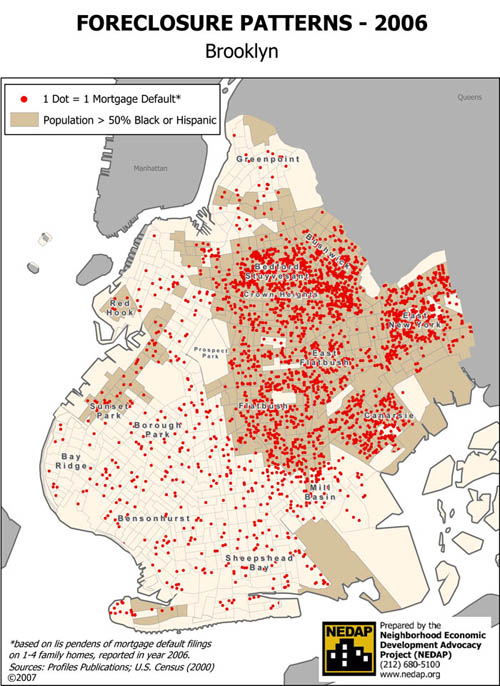
You have to dig to find out that, for instance, more African borrowers making upwards of $100,000 a year were given subprime mortgages than were whites making under $40,000. African communities were targeted for subprime and adjustable rate mortgages as a very lucrative new market for loan sharks.
Cities with large African populations tell the story: Atlanta (map), Cleveland (map), Detroit, Brooklyn (map), to name a few.
Early in this decade the government and the Fed began lowering interest rates. Housing prices skyrocketed and millions of Americans began tapping into their home equity, fueling a "wealth effect" and massive spending.
The lower rates sparked the speculative housing market and gentrification, as lower income white people could suddenly become homeowners by buying in an African community. Or they could become entrepreneurs by buying up "ugly houses" to flip.
TV channels were spawned by gentrification and a whole economy centered on Lowe's, Home Depot, Restoration Hardware, Starbucks, art galleries and cute restaurants. Houses of Africans, including the elderly, were taken from under them as white people demanded that code violations be enforced for their benefit.
As housing prices in African neighborhoods skyrocketed, the culture of the community was criminalized and police presence intensified to protect the white "pioneers" from the surrounding impoverished population. African people were dispersed further and further into decaying suburbs, crunched in with other family members or sent to government-sponsored prison housing.
None of this is new, however. It's the same story that has played out for more than half a millennium.
Since African human beings were first abducted at gunpoint from Africa, turned into a commodity and transported to America as well-insured cargo, stacked on pallets in the holds of ships, the Western world has gotten its economic stimulus from the oppression of others.
More than anything, America sits on the backs of Africans.
Today we talk about oil prices and fluctuations in the stock market, but there were whole centuries when the price of an African was the most important topic at businessmen's lunches in New York and London. The Wall Street stock exchange sits on the site of New York auction blocks and slave ship docks.
The African cemetery found under a high rise building on Wall Street is the perfect metaphor for this country: America's wealth resting literally on the bodies of African people.
As Omali Yeshitela proves in his books Omali Yeshitela Speaks and One Africa! One Nation!, Europe was a cold, barren, impoverished and war-like place in the Middle Ages. It was characterized by oppression, plague and feudal serfdom when it set out to rescue itself by ravaging Africa.
Henry the Navigator of Portugal sent ships out to the coast of West Africa around 1420, and by the year 1500 Europe had already extracted 81,000 African people and 700 tons of gold from Africa.
Around the same time Columbus began the process of massive genocide of the Indigenous people of the Americas and the theft of their land and resources.
We are taught ridiculous myths that somehow Europe worked hard, saved its money and thus became the dominant economic and military power in the world. But an honest look at history shows that the development of wealth and power in Europe parallels its assault on Africa and other peoples every step of the way.
In the 1500s the Spanish government monopolized the trade in African human beings, even as the governments of Holland, England and France were waiting in the wings. They would all go to war for a piece of this most valuable commodity, just as oil wars are being fought today.
Independent businessmen also wanted some of this loot, financing their own ships as pirates or "privateers" under the banner of "free trade." Entrepreneurs like Jean Lafitte raided the state-owned slave ships laden with human cargo and made a fortune selling Africans off the coast of New Orleans at discount rates.
As Yeshitela, again points out, the trade in African people did far more than make southern plantation owners wealthy. The plantations are long gone but the wealth of African enslavement has been compounded in the overall economy of America a million times over.
What part of Europe's and America's economy did not get started on the human trade? Banking, insurance, ship building, industry, universities, tourism, railroads, housing, hotels, law firms, the garment industry, retail sales, Wall Street itself were all spawned by African enslavement.
We're taught that Africans became "free" after the official enslavement ended in 1865 in the U.S. In reality other forms of African exploitation were found to be more lucrative for the Western economy.
In Africa Europe imposed direct colonialism. There was no word for "genocide" when Europe and America were slaughtering millions of African people on the continent as they ripped out diamonds, rubber, ivory, gold, and other precious resources that further consolidated Western wealth and power.
Rarely discussed, but extremely important to America's wealth, is the system of convict leasing. For more than 70 years thousands of African people were rounded up under Jim Crow laws, kept in work camps and leased out by state governments to plantations, limestone and phosphorus mines, road gangs and logging teams.
The brutal system of convict leasing rebuilt the economy of the southern states following the Civil War. In the late 19th century more than 80 percent of the revenue of Alabama came from convict leasing. I have read that Hitler modeled work camps on the convict leasing system, which was known to be worse than slavery. The white people's motto was, "One dies, get another."
European immigrants coming to America were pretty clear that American "opportunities" came to them because of African enslavement and the genocide against the Indigenous people.
Throughout most of the 19th century street gangs made up of white workers in northern cities functioned as a terrorist force against African people who had escaped to the north.
Lynching was the popular pastime of white America for a hundred years. These chilling festivals of violence had the avid participation of the whole white family. Children were dressed up and posed for photographs in front of the lifeless bodies of African people. This public torture and murder of African people was accompanied by music, dancing and food vendors.
White people terrorized Africans who were prospering in independent economic communities. Tulsa, Oklahoma and Rosewood, Florida are only the most famous examples of this. All over the country Africans banded together, buying land and setting up collective economic ventures that were quite successful, but these were destroyed one after another. White people would never allow Africans to become more prosperous than they.
Similarly, the media tell us the reason Africa is poor today is because its leaders are "corrupt." But every time an African leader rises up, demanding that the resources of his country benefit the people, the leader has been assassinated or overthrown by America or Europe — from Patrice Lumumba to Kwame Nkrumah to Thomas Sankara.
It's not corruption; it's the U.S. policy of neocolonialism, which ensures that Africa's resources stay in the pocket of Western powers. I have read that more than 80 percent of all the mineral resources the U.S. needs to function are in Africa. This is the basis for the U.S. militarization of Africa under AFRICOM.
In this country, after the leaders of the Black Power Movement of the 1960s were assassinated or imprisoned by the government, the U.S. began flooding African communities with drugs: heroin and later crack cocaine. This is well-documented from many sources.
We cannot underestimate the importance of this illegal drug trade to the U.S. economy. Said by the United Nations to be worth more than $500 billion a year, illegal drugs constitute the third largest commodity in the world, behind oil and arms.
Clearly those billions of narco-dollars are not floating around in African communities, but rather buy the cars, mansions and private jets of the Wall Street elite. They also benefit white society as a whole. Since the late 70s drug money has funded real estate, car dealerships, jewelry stores, restaurants and more.
Meanwhile, the African community is left with a government-imposed, penny-ante illegal drug economy that primarily serves to criminalize the entire African population. The imposed drug economy feeds the prison industry, another booming component of the U.S. economy.
More than half of the 2.3 million prisoners in the U.S. today are African, the cornerstone of a $50 billion industry. Called the new gold rush, the prison industry has spawned countless spin-off businesses, including phone companies, clothing, construction, vending machines, instruments of suppression and more.
Most prisons are filled with urban Africans but located in rural white America, where prisons are the third largest industry, behind gambling and pig farming. Many states have a conscious strategy to use prisons as economic stimulus for rural counties, providing white high school graduates high paying jobs as guards.
Some people are predicting that the subprime collapse along with the low dollar and high oil prices could bring about the demise of the U.S. economy.
If so, it's just the logical conclusion of an obese, parasitic economic system that has been sitting on a shaky foundation of enslavement and genocide for more than 500 years.
Penny Hess is author of Overturning the Culture of Violence and the chair of the African People's Solidarity Committee which is led by the African People's Socialist Party. Her analysis is based on the understandings of Omali Yeshitela. She can be reached at info@apscuhuru.org
Thursday, December 13, 2007
How to Start A Neighborhood Association
Neighborhood Associations bring the community together in order to improve the quality of life for all its residents. If you're looking at this article, there must already be something about your neighborhood that you want to change or you're concerned about, or you may just want to maintain and protect all that is good about it. To accomplish these goals, and build a sense of unity in your community, starting a neighborhood association is a positive step in the right direction.
The goal of a neighborhood association is to help enhance the quality of life in a neighborhood , and help make it a safer and more enriching place to live. If your neighborhood is already in great shape, an active neighborhood group can help it to stay that way, raising the residents' feleing of partnership with those living around them, and giving the community an effective communications link and a voice to speak to government officials, staff , developers and other influential groups.
Getting Your Neighbors Together
A well-organized group of neighbors can be a powerful and influential force coming together to address common problems in their community. Convince them that in unity there is strength! Survey the residents in your neighborhood, then with the solicited data, develop a draft of the platform and take it back out to the community to solicit feedback. The draft platform will take into account the needs, demands and concerns expressed by your neighbors through the survey and molds the association into a vehicle to address those concerns.
Business Plan / Neighborhood Plan
Once you've gotten your neighbors interested in forming a neighborhood association, decide when you will hold your first meeting. The first order of business for individuals attending the meeting should be to ratify the "Neighborhood Plan". The plan should be reviewed from time to time to assess what goals have been accomplished and what needs to be re-evaluated or removed from the plan. New goals can be included as they arise.
The following elements should be included in your "Neighborhood Plan":
- Mission Statement
- Goals
- By-Laws
- Road Map for the First Year
- Gathering Neighbors and Business Owners
- Support Committees
- Fund-raising
- Effective Communication Methods
- Place a Public Notice in the newspaper indicating time and place of your first community meeting
Tips to Remember
- Attract, Maintain, Recruit new members
- Involve all residents regardless of race, religion, age and socio-economic status
- Provide Success and status reports to your community
- Identity and form partnerships with schools, businesses, centers of worship, local government, hospital, realty companies, libraries, and communiaty centers
- Constantly reassess the neighborhood plan to insure that it is still working for the neighborhood!