Monday, December 10, 2007

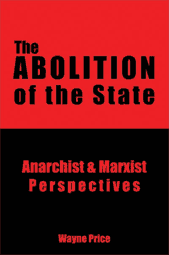
Book Review: “The Abolition of the State”


Book Review: “The Abolition of the State”


(Wayne Price, Author House, 2007)


The regular contributor of Anarkismo.net, Wayne Price, comes back with a book that details the anarchist-communist criticism of the State both from a theoretical as well as historical point of view. Because of the magnitude of such a task, it is impossible for such a book to examine in length the various aspects of this. But the book is full of ideas and notions that can be developed further. The whole of the book is free of heavy academic jargon, quite easy reading and thought provoking.

The biggest merit of the book is to put forward the anarchist case against the State in a very commonsensical fashion, free of any deliberately hard to follow rhetoric. Anarchism is desirable and easy enough to grasp, and when properly explained –as this book does- it is hard for anyone not to share the basic anarchist outlook of a cooperative and truly democratic society.

Although a number of leftists and anarchist, including the famous Platform of the Dielo Trouda group, to which the author subscribes, reject the very concept of “democracy” for considering it too intertwined with capitalism, this, as proved in the book, is really a discussion of form but not of content. What really matter are the core ideas more than the words employed. Wayne uses the term democracy in its original and literal sense and not in the distorted and opportunistic way in which western politicians tend to manipulate it. In capitalism, as proved by the experience of Chile, Bolivia, Argentina, Spain, Greece, etc., “democracy” (limited, bourgeois, invigilated) and dictatorship are nothing but two facades of capitalist rule which often go hand in hand. This fact only demonstrates how quick the capitalist clique is willing to abandon its “lofty” democratic principles when they see their economic privilege challenged.

Anarchism, as Wayne says, is nothing but democracy without the State, a genuine form of democracy, since capitalist democracy is nothing but the illusion of majority rule while actual power is held by a tiny minority of rich men who control the economy, the bureaucracy and the military, thus controlling the lives of the powerless millions. On the contrary, anarchism is an organic form of democracy, emanating from below, from each and all of those who are part of a society which is built by everyone. For this democratic society to exist, not only the State, but also the unequal distribution of wealth and the reign of private property need to be challenged.

But anarchism, as emphasised by the author from the very beginning, is not merely an economic and political programme, but it also challenges the network of daily oppressions we experience at all levels of our lives. It therefore advances a new ethic that sticks strongly together its political and economic alternative with a new way of relating between diverse equals.

The main case of the book is that ordinary people, on a number of revolutionary situations throughout history (of which Wayne goes to review only the Spanish and Russian revolutions, as well as the Paris Commune, although he mentions many others, from Chile to Germany), have, again and again, replaced State for other forms of direct democracy to run their own affairs. So therefore, the whole argument of “how would society be without the State” is answered just by a simple exercise: look at the history of working class revolutions and many answers will be provided there. Of course historical experiences cannot be replicated; still, they provide insights in the future possibilities and more importantly, they prove the anarchist case for a Stateless society as viable and desirable.

Wayne does not pretend for a second that anarchism has all of the solutions to magically create a new society, but has a number of powerful criticisms, outlooks and proposals. This is why he resorts to dialogue with other political currents in the social movement: mainly Marxists, but also radical liberals, as well as market socialists. He proves in various cases the existence of common perspectives in many of these political currents and the existence of a libertarian and an authoritarian trend in every single one among them. Anarchists, therefore, do not come from the moon: it is only the articulate and coherent political elaboration of tendencies to be found widespread among the working class and ordinary people. Because of this, revolution after revolution, we see the same elements emerging in proposals for social construction: the egalitarian character common to all of the communist tendencies and an emphasis on direct democracy that has developed better in anarchism than in any other current.

I’m particularly fond of Wayne’s approach in engaging in respectful dialogue with other currents of the left. This, because for most of the left, the main, long-term goals are the same; the problem, as Wayne poses it, is the transition period. Most Marxist currents have argued that during the transition period, in a transitory fashion, the State would remain necessary: some form of State would be required mainly for the necessary coercion against the class enemies. Therefore, there’s an emphasis in centralisation in the revolutionary endeavours to build a new society, drive which has turned good intentions into nightmarish totalitarianisms. Though we can sit back and say the road to hell is full of good intentions, we ought to acknowledge the need of engaging in that dialogue –because different to a Hitler who knew what he was doing (and who talked the language of authority and supremacy), the development of socialist totalitarianism was an ugly result, unavoidable because of the tactics employed, of a programme which genuinely tried to change society for the better. Then bureaucratism and the development of the totalitarian State ended up burying any good intentions left –often, burying with them those very revolutionaries which helped build the new regime.

While acknowledging that some of those tasks currently undertaken by the State will be necessary in a post-revolutionary society –even coercion-, Wayne convincingly argues that democratic, grassroots organisations can carry them perfectly, without the burden of a bureaucracy, of an elite placed above the rest of society making politics instead of the people –and without the risk of restoration of a new class society inherent to any State. Of course this type of grassroots political organisms will vary greatly from place to place, according to the needs of particular peoples, or their history and traditions. It is certainly impossible and not desirable to come up with a mould to apply everywhere at any time. It would not be libertarian to proceed in such a way either. It is the popular genius which has proven wise enough to come up with the best solutions for specific contexts in history and we know that this same genius will be always looking for its way forward in history through its own experience. Because of this, Wayne thinks it is much better to talk of an “experimental” rather than a “transitional society”. The sole guideline we need, as Wayne brilliantly sums it up avoiding any false dichotomy, is that there is as little centralisation and hierarchy as possible, and as much decentralisation, autonomy and grassroots decision making as possible. And here lies another merit of his work: he refuses to see federalism as an absolute opposite to centralism. Federalism, at least in the anarchist sense of the word, means nothing but the right balance between the minimum reasonable and necessary level of centralisation and the maximum viable level of autonomy.

This respectful dialogue with other political currents is much required, not only to build “bridges” with those sections of the people who hold ideas different to us –although their intentions may be equivalent- but also to reach a proper understanding of why revolutionary experiences have failed and often have gone internally rotten by authoritarianism. A political understanding of, for instance, the Russian failure needs to acknowledge the problem of means and ends, instead of the moralistic muddle-headed platitudes of goodies and baddies which, unfortunately, plague anarchist literature. This means also to start getting rid of ill-definitions which add up nothing to our understanding of reality, but actually obscure it. Terms like “red fascist”, to refer Leninism, only clarify that those who use it whether don’t know anything about fascism or they don’t properly understand Leninism. Interestingly, Wayne analyses the failure to stop the rise of Nazism in the ‘30s Germany and deals with the ill-definitions of the German Communist Party, borrowed from the maniac sectarianism of Third Period international Communism. They labelled basically anyone out of its ranks as a fascist: thus, the social-democrats being social-fascists and anarchists being anarcho-fascists, they were unable to tell the real danger of fascism coming. This sectarianism did actually open the doors for fascism to get in without many problems. It is not too difficult to draw parallels between the sectarianism of Stalinism with the sectarianism often prevalent amongst some anarchists. The elitist attitude is the same and so is generally speaking the frame of mind of both extremes.

Another important aspect of Wayne’s work is to challenge the belief, still prevalent among the old-fashioned left, that centralisation in the economic arena is more efficient or even as necessary as usually assumed. Therefore, anarchist federalism is dismissed as unsound to deal with the complexities of modern production and life. The actual evidence, though, contradicts this simplistic view: recent economic transformations show that actually capitalism in its drive to increase productivity has moved from centralism to increased levels of decentralisation. Most modern and post-Fayol theoreticians of management, stress the need to tear down strict hierarchies in the workplace, rotate workers in chain production, get rid of unnecessary repetition and routine, introduce limited levels of participation of workers in some decision-making and planning, what they even disguise in theory as forms of “self-management”, etc. with an overall view at de-centralisation. I’m referring to authors such as Tom Peters (“Liberation Management”)[1]. This, they have proved, leads to an increase productivity and motivation of the workforce.

This tendency, however, pose its own problems for workers as a class: often, these privileges are reserved to the most specialised and well-off segments of the working force (such as professionals, technicians or specialists with a high degree of training) and, generally speaking, the main idea of this is to make workers accomplices of their own exploitation. In as much as property is not touched and the upper hand remains in the hands of the bourgeois few, the bosses can allow no problem some levels of “democracy” inside of the workplace.

Also, we have to bear in mind that decentralisation and outsourcing, are all terms frequently used by the capitalist class, sometimes aiming at dismantling the mammoth State corporations and facilitating capitalist intervention; other times (as in Chile after the Piñera labour laws of 1980) to make it easier to divide workers and weakening their unions. What I want to stress, is that decentralisation per se is not inherently revolutionary. It can be used by the capitalist class to the achievement of its own purposes as long as property is untouched. While Wayne spends a significant amount of effort demonstrating how centralism has been used by capitalism for financial and political purposes, he fails to spend a similar amount of time proving the same case about decentralisation. It is relevant to insist on this point, particularly in the IT era where we are standing when centralisation has been made, in just a decade, altogether redundant.

Whatever the case, the development of modern capitalism demonstrates that even some limited amounts of self-management and human resource management techniques aimed at motivating workers, prove the case of anarchists: workers control is not only best for workers, but also for productivity. This was already proved in revolutionary terms by the Barcelona commune during the Spanish Revolution of 1936. Over half a century later, it wouldn’t be such an exaggeration to say that it is the very capitalist system, through the IT and management developments of the last decade, which has done more for the advancement of the communist cause than all of the left together. However, we know that none of these transformations, while developing and expanding the “objective” conditions for an emancipated society, will lead mechanically to a new society. In fact, they are only serving to increase levels of alienation of the working class and increase the gap between the classes by maximizing profits in a way never seen before in history. Without a conscious organised anarchist and revolutionary political force, we can wait forever more. And this force has to challenge the sources of power of the bourgeoisie –this is what Wayne refers as “taking power”, a term that may be problematic to some anarchists but which any honest reader will not fail to understand in context as free of any authoritarian connotation.

Only challenging those sources of power –what can only be done through revolutionary means as proven by experience- can we aim at building a truly democratic and humane society. Because, we can’t forget that capitalism not only is undemocratic and alienating, but also is a system plagued of atrocities. Although we often insist on the abominations of both Nazism and Stalinism, it is not too often that we focus on the evils of Capitalism. And I’m not even thinking on the evils of colonialism, closely linked to the development of the capitalist system. We actually could go on forever on the atrocities practised by the Belgian in Congo, by the French in Algeria, or the famines caused by the British authorities in India. I won’t even focus on the murderous slaughters caused by imperialist aggression in the XXth Century. We could talk forever on the US invasions of the Philippines, their atrocities in Central America, Hiroshima, Nagasaki, Vietnam or the carnival of mayhem taking place currently in Iraq. We could talk forever of the English in Kenya or Dresden.

But I won’t refer to any of this. I am just thinking on the silent massacre of 25,000 people a day out of starvation, not to talk of those who die for lack of safe access to water and preventable diseases -all this in a world of abundance. This figure alone should be enough condemnation of the capitalist regime –if we lived in a sane society. This is not just an “unwanted” result of otherwise good politics that over time can be ameliorated. This is the direct and well known result of the application of deliberate economic policies and structural adjustment programmes designed in the capitalist centres of the world, unconcerned of the tragedies that they unfold, and reinforced by a myriad on international financial institutions. Even the UN report on Human Development (2006) states that “Like hunger, deprivation in access to water is a silent crisis experienced by the poor and tolerated by those with the resources, the technology and the political power to end it”[2]. We have to state clearly that this crisis is not only “tolerated” by those with the wealth and power: it is they who have actually created it. It is the direct result of capitalism at a global scale. And these nasty “side-effects” of capitalism have not been ameliorated with time –they’re getting worse and worse each passing day. Added to the ecological crisis, caused also by the senseless waste of capitalist society, it is capitalism the main responsible of periodical famines in many parts of the Third World. So much has been written about the “black book” of communism or fascism, but capitalism has as many skeletons in its closet and its black book is jet black as anything.

As Wayne correctly states, the State, even the most democratic of them is not properly democratic. But not only is it undemocratic. It is murderous too. For those reasons it should be abolished. All of the conditions are there for us to start with this task. And Wayne’s book is definitely a contribution to explore the possibilities of a genuinely free society.

José Antonio Gutiérrez Danton
November 4th, 2007


http://www.anarkismo.net/newswire.php?story_id=6798

Friday, December 7, 2007

Fallen Soldiers Friday: Picture Memorial

Every Friday I will post a biography of an honored hero in the revolutionary struggle. Some will be well-known freedom fighters like VI Lenin or Emma Goldstein, others, so not well known. Because not all believed in the same strategy to achieve liberation, we will see a conflict of ideas. Something that we can draw upon to construct our views today.

Today, I will be posting up pictures of comrades who gave their energy and devoted their life to the struggle for liberation.

To pay tribute, leave a comment in remembrance of a fallen soldier whom has influenced you in any way shape or form.


Jean Baptiste DuSable


Huey P. Newton


Osageyfo Kwame Nkrumah


Kwame Toure


"Chairman" Fred Hampton


MLK


Malcolm X


Thursday, December 6, 2007

African Anarchists Reorganize for Revolution


The Zabalaza Anarchist Communist Federation was replaced by a new, unitary organisation, the Zabalaza Anarchist Communist Front. On December 2, the members of the new ZACF held talks with Swazi comrades with a view to establishing a new unitary organisation in Swaziland. The new Front's constitution follows.

As adopted at Johannesburg, 1 December 2007

The ZACF defines Anarchism as:

“…society organised without authority, meaning by authority the power to impose one’s own will ... authority not only is not necessary for social organisation but, far from benefiting it, lives on it parasitically, hampers its development, and uses its advantages for the special benefit of a particular class which exploits and oppresses the others”.
Errico Malatestal , Agitazione June 4, 1897


And Communism as:

“Common possession of the necessaries for production imply[ing] the common enjoyment of the fruits of the common production; and we consider that an equitable organisation of society can only arise when every wage-system is abandoned, and when everybody, contributing for the common well-being to the full extent of [their] capacities, shall enjoy also from the common stock of society to the fullest possible extent of [their] needs.”
Piotr Kropotkin , Anarchist Communism: Its Basis and Principles,1887


PREAMBLE


We, the working class, produce the world’s wealth. We ought to enjoy the benefits.


We want to abolish the system of capitalism that places wealth and power in the hands of a few, and replace it with workers self-management and socialism.


We do not mean the lie called ‘socialism’ practised in Russia, China, and other police states - the system in those countries was/is no more than another form of capitalism - state capitalism.


We stand for a new society where there will be no bosses or bureaucrats. A society that will be run in a truly democratic way by working people, through federations of community and workplace committees.


We want to abolish authoritarian relationships and replace them with control from the bottom up - not the top down. All the industries, all the means of production and distribution will be commonly owned, and placed under the management of those working in them. Production will be co-ordinated, organised and planned by the federation of elected and recallable workplace and community committees, not for profit but to meet our needs. The guiding principle will be “from each according to ability, to each according to need”.


We are opposed to all coercive authority; we believe that the only limit on the freedom of the individual is that their freedom does not interfere with the freedom of others.


We do not ask to be made rulers nor do we intend to seize power “on behalf of the working class”. Instead, we hold that socialism can only be created by the mass of ordinary people. Anything less is bound to lead to no more than replacing one set of bosses with another.


We are opposed to the state because it is not neutral, it cannot be made to serve our interests. The structures of the state are only necessary when a minority seeks to rule over the majority.


We can create our own structures, which will be open and democratic, to ensure the efficient running of everyday life.


We are proud to be part of the tradition of libertarian socialism, of anarchism. The anarchist movement has taken root in the working class of many countries because it serves our interests - not the interests of the power seekers and professional politicians.


In short we fight for the immediate needs and interests of our class under the existing set up, while seeking to encourage the necessary understanding and activity to overthrow capitalism and its state, and lead to the birth of a free and equal (anarchist) society.


Full constitution of ZACF found here


“zabalaza” being the indigenous word meaning “struggle” in Zulu and Xhosa

Wednesday, December 5, 2007

The Treatment of African Slaves


This paper hopes to illustrate the barbaric and inhumane treatment of Africans during slavery in contrast to the pro-slavery counter-claims of fair treatment towards slaves. There is a famous African proverb which states, “Until the lion writes its own history, the tale of the hunt will always glorify the hunter.” Meaning until slaves themselves were able to document their treatment or until others on their behalf exposed the truth, the true nature of slavery would never be know, and the “happy slave” myth would continue to perpetuate. Mary Prince in her narrative declared, “All slaves want to be free” and states, “I can tell by myself what other slaves feel, and by what they have told me. The man that says slaves be quite happy in slavery – that they don’t want to be free – that man is either ignorant or a lying person. I never heard a slave say so.”

Mary Prince’s The History of Mary Prince, a West Indian Slave, Related by Herself is the earliest know slave narrative by a woman, which highlights the treatment of slaves. It was published in 1831, almost 300 years after the first African slave was transported from the African coast. It is a saga of overwork, abuse and sexual violence that well over 10 million unnamed slaved had experienced during Colonial Slavery. She details horrific scenes of physical abuse inflicted upon her by her mistress. She says, “To stripe me naked – to hang me up by the wrists and lay my flesh open with the cow skin, was an ordinary punishment for a slight offense. However, she soon details a far worse scene of brutal treatment towards the slaves by describing what happened to a fellow slave of hers named Hetty after a cow she had tied up had gotten loose. She says, her “master flew into a terrible passion, and ordered the poor creature(Hetty) to be stripped naked, notwithstanding her pregnancy, and to be tied up to a tree in the yard. He then flogged her as hard as he could lick, both whip and cow skin, till she was all streaming with blood. He retired, and the hit her again and again. Her shrieks were terrible.” After the brutal beating, she was brought to bed where she give birth to a still born child. After seemingly recovering, she was again repeatedly beaten by the mistress and master and later died due to her injuries. Mary goes on to say that that day filled her with horror and could not bear to think of it, but it was always present in her head for a long time. This small statement showcases not only the physical trauma that the slaves suffered but also the emotional and psychological trauma they experience and developed due to inhumane treatment of themselves and other fellow slaves on the plantation.

Olaudah Equinao was a former slave who authored a slave narrative when freed. In the narrative he witnessed a horrific scene also. He says he saw, “a negro man staked to the ground and cut most shockingly, and then his ears cut off, bit, bit by bit, because he had been connected to a white woman, who was a common prostitute!” As if it were no crime in the whites to rob an innocent African girl of her virtue; but most heinous of a black man only to gratify a passion of nature, where the temptation was offered by one of a different color, though the most abandoned woman of her species.”

The act of raping an African slave was legal and a normal occurrence during slavery. Due to the fact that Africans where not thought of as humans, but as property, they did not have rights which whites enjoyed. Rape by nature is a violent act, whether the victim puts up a struggle or not. This is because rape is when a victim is forced into a sexual act against his or her will. The fact that it was legal to rape an African, because she was a slave, shows the barbaric and inhumane nature of slavery.

Rape is just many of the gruesome and violent acts committed against Africans during slavery. As noted in the slave narratives, many of the slaves were beaten so severe that their injuries were life threatening. The psychological effect of being beaten brutally or seeing someone else beaten could cause post traumatic syndrome. Showing that not only was slavery physically abusive but also mentally. The slave narratives stand in sharp contrast to the pro-slavery stories of a happy and well treated slave and also shows how important it is for the lion to write it’s own story.

Saturday, December 1, 2007

Why Revolutionaries Cling To DM Like Grim Death


by Rosa Lichtenstein

No matter how deep, long-term or devastating the refutations history delivers, and despite the cogent arguments ranged against it in my Essays, the DM-faithful remain hopelessly mesmerised by their 'theory'.

Why is this? And why have revolutionaries of the stature of Engels, Lenin and Trotsky sold their radical souls to this conservative thought-form? [Marx was an exception; on this, see here and here.]

The historical origin of the philosophical system underlying DM is not in any doubt (a summary can be found here), and neither are the class origins of DM-classicists (like Engels, Plekhanov, Lenin and Trotsky). In that case, dialectics itself has impressive alien-class credentials.

It is important to note, however, that it is not being alleged here that the above comrades imported these alien ideas knowingly or duplicitously; it is being asserted that they did this honestly but unwittingly.

Honestly, because they genuinely thought that the movement needed a Philosophy; unwittingly, because the only theories on offer in their day were those that had already been compromised by ruling-class concepts and forms-of-thought (which these comrades failed to appreciate). [More on that below.]

This does not of course mean that only workers can be good socialists, but it does mean that we should be alert to the class-compromised origin of the ideas that DM-classicists brought with them into our movement -- before the working class could provide them with an effective materialist counter-weight.

Today, a hundred or more years later, there is no longer any excuse for continuing to import these ideas, since that counter-weight now exists.

However, this does help explain a rather curious anomaly: as the working-class daily grows bigger, the influence that Dialectical Marxism has on it dwindles ever faster.

Parallel to this, but not unrelated to it, our movement continues to splinter, and thus has decreasing influence on the class struggle. Moreover, the fact that workers ignore our movement en masse means that their counter-weight has no influence where it counts: on our ideas.

So Marxist Idealism lives on, as its theorists think of new ways to make such awkward facts disappear.

The lack of active socialist workers means that the unifying force of the class struggle by-passes the revolutionary movement, which, because it is dominated by petty-bourgeois individuals, does little other than fragment (for well-known social-psychological reasons; on this, see here).

Hence, the same social forces that compel workers to unite, drive professional revolutionaries in the opposite direction, and toward fragmentation.

A rather ironic 'dialectical' inversion in itself!

But, are these accusations enough to condemn DM? Clearly, not on their own.

DM is demonstrably flawed from end to end (as my Essays show); that fact alone is enough to condemn it. But, the dubious class-origin of both "materialist dialectics" and its originators explains why this theory has had such a deleterious effect on militant minds, rendering our movement all but impotent. It also helps account for the disastrous effect it has had on post 1920s Marxism.

But why do hard-headed revolutionaries cling to this lamentable theory like drunks do to lamp posts?

Marxists are aware that in defeat the tendency (even among revolutionaries) is to turn to mysticism both as a means of explanation and as a source of consolation. This was indeed one of the main reasons why Lenin wrote Materialism and Empirio-Criticism.

Alas, Marxism has faced little other than defeat and set-back for most of its history.

However, the theory that played an important subjective role in engineering this catastrophic state of affairs also enables its adherents to ignore it.

This it does in at least two ways:

1) The NON[Negation of the Negation] informs believers that any and all retreats are only temporary; the onward march of Marxism is assured by the underlying logic of history. [We saw this surface in Excuse Four, above.]

2) DM-epistemology teaches that appearances contradict underlying "essences" -- i.e., how things appear to be is the opposite of the way they really are. This being so, what might seem to be (i.e., to the dialectically untrained eye) a series of defeats, is really part of the long-term success of Marxism --, or, perhaps, part of a run of successes about to begin, any day soon...

Hence, the theory that has helped engineer these set-backs also says that they have not really taken place, that they are other than they seem, or that they do not matter.

Anyone who doubts this should try telling any randomly-selected, dialectically-distracted comrade that Marxism is highly unsuccessful. Unless you are extraordinarily unlucky, you can expect to be subjected to some ludicrously tortured logic that will attempt to prove otherwise.

The latter will include a convoluted explanation as to why, when 99% of the working class ignores Marxism --, and has done so for many generations --, and all four Internationals have gone down the pan, and the vast majority of the former 'socialist' states have gone into reverse, and Marxist parties (especially the Trotskyist variety) everywhere are a by-word for splits and divisions (indeed they are a standing joke in this regard),2 and even though practically every communist party on the planet has embraced open reformism, meaning that we are now further away from establishing a Workers' State than the Bolsheviks were in 1921 --, that none of this matters, or has actually happened, or is really now happening, or is any part of the particular 'tradition' to which this sad soul belongs.

You see, the other "sects" are to blame; it's a failure of revolutionary "leadership" -- their failure, you understand, not ours.

Alternatively, the "objective circumstances" ploy will be dusted-off, and given another spin around the dialectical exercise yard.

Nevertheless, you will probably then be informed of the good news that the latest stunt, conference, intervention, split, or expulsion that the 'party' (to which this sad dreamer belongs) has just pulled off (or is about to stage) heralds the long-awaited turning-point for the international proletariat.2a

Without a hint of irony -- still less of embarrassment --, this comrade will pronounce such verities on behalf of at most 0.00001% of the working class (this being the entire membership of his or her tiny grouplet (formed largely of non-workers)), some of whom, anyway, are about to be expelled from this 'Worker's Party' --, probably for failing to 'understand' "materialist dialectics"!

And, as sure as eggs are not dialectical eggs, this comrade will fail to see the connection between such facts and such failures --, and give you a hard time for even thinking to question the sacred gospel.

Or, if you belong to another "sect", you can expect to be called a "bourgeois stooge", or worse.

Those familiar with Marxist/revolutionary papers will already know of their unsinkable optimism -- how almost all claim to be the only one that is "leading the class", and how Capitalism is once again entering its "final crisis" (it apparently having more lives than a lorry load of cats).

But, all that this will confirm is how unreasonable dialecticians can be, and how they are prepared to bend every rule in order to protect the semi-divine dialectic.

So, Dialectical Marxists cling to this 'theory' because without it their entire world-view would fall apart, and their sole source of consolation would disappear. In short, they are super-glued (crazy-glued) to dialectics for the same reason that religious folk cling on to their faith. [More on this here.]

That, of course, explains the mind-numbing, mantra-like repetitiveness of DM, the pathological fear of the "R" word ("Revisionism" -- which attitude conveniently forgets that no science is beyond revision), the sacred books, the appeal to 'orthodoxy', the heroic pictures of the dialectical saints carried on parades (Marx, Engels, Lenin, Stalin, Mao, Che, Kim Jong-il, etc., etc.), and the inexplicable adherence to the Stone Age Logic found in a thinly-disguised work of mystical theology that celebrates the goings-on of an invisible 'Being' (i.e., Hegel's 'Logic').

If this wasn't quite so serious, you'd laugh.


For more about Dialectics and why this theory should be dumped, visit Rosa Lichtenstein @nti-Dialectics for Absolute Beginners.