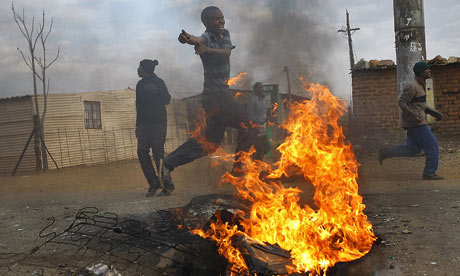
In South Africa the state is being confronted by an eruption of self organised popular protest on a scale not seen since the 1980s. This article, from the mainstream press there, gives a much better overview than the articles in the British press that miss the politics of the rebellion.
Burning message to the state in the fire of poor’s rebellion
Richard Pithouse
DU NOON, Diepsloot, Dinokana, Khayelitsha, KwaZakhele, Masiphumelele, Lindelani, Piet Retief and Samora Machel. We are back, after a brief lull during the election, to road blockades, burnt-out police cars and the whole sorry mess of tear gas, stun grenades and mass arrests. Already this month, a girl has been shot in the head in KwaZakhele, three men have been shot dead in Piet Retief, and a man from Khayelitsha is in a critical condition.
There are many countries where a single death at the hands of the police can tear apart the contract by which the people accept the authority of the state. But this is not Greece. Here the lives of the black poor count for something between very little and nothing. When the fate of protesters killed or wounded by the police makes it into the elite public sphere, they are generally not even named.
The African National Congress (ANC) has responded to the new surge in popular protest with the same patrician incomprehension under Jacob Zuma as it did under Thabo Mbeki. It has not understood that people do not take to the streets against a police force as habitually brutal as ours without good cause. Government statements about the virtues of law and order, empty rhetoric about its willingness to engage, and threats to ensure zero tolerance of “anarchy” only compound the distance between the state and the faction of its people engaged in open rebellion.
Any state confronted with popular defiance has two choices — repression or engagement. If it wishes to avoid shooting its people as an ordinary administrative matter, the first step towards engaging with popular defiance is to understand the dissonance between popular experience and popular morality that puts people at odds with the state.
A key barrier towards elite understanding of the five-year hydra-like urban rebellion is that protests are more or less uniformly labelled as “service delivery protests”. This label is well suited to those elites who are attracted to the technocratic fantasy of a smooth and post-political developmental space in which experts engineer rational development solutions from above. Once all protests are automatically understood to be about a demand for “service delivery” they can be safely understood as a demand for more efficiency from the current development model rather than any kind of challenge to that model. Of course, many protests have been organised around demands for services within the current development paradigm and so there certainly are instances in which the term has value. But the reason why the automatic use of the term “service delivery protest” obscures more than it illuminates is that protests are often a direct challenge to the post-apartheid development model.
Disputes around housing are the chief cause of popular friction with the state. The state tends to reduce the urban crisis, of which the housing shortage is one symptom, to a simple question of a housing backlog and to measure progress via the number of houses or “housing opportunities” it “delivers”. But one of the most common reasons for protests is outright rejection of forced removals from well-located shacks to peripheral housing developments or “transit camps”. Another is the denial or active removal of basic services from shack settlements to persuade people to accept relocation. Moreover, to make its targets for “housing delivery” more manageable, the state often, against its own law and policy, provides houses only for shack owners, resulting in shack renters being illegally left homeless when “development comes”.
It is therefore hardly helpful to assume that protests against forced removals and housing developments that leave people homeless are a demand for more efficient “delivery”. On the contrary, these protests are much more fruitfully understood as a demand for a more inclusive mode of development, in the double sense of including poor people in the cities and of including all poor people in development projects.
If the state actually engaged with any seriousness with the people to whom it has promised to “deliver services”, these kinds of problems could be resolved. But the reality is that the state very often imposes development projects on people without any kind of meaningful engagement. One reason for this is the pressure to meet “delivery targets” quickly — a pressure that was greatly worsened by the ludicrous and dangerously denialist fantasy of former housing minister Lindiwe Sisulu that shacks could be “eradicated by 2014”.
Another reason why the state systematically fails to engage with poor people is that when it does negotiate, it tends to substitute ward councillors and their committees, as well as local branch executive committees of the ANC, for the communities actually affected by development projects. But the fact is that in many wards the councillors and local party elites represent the interests of local elites, who often have very different interests to poor communities. Moreover, it’s entirely typical for these local elites to seize control of key aspects of development projects, such as the awarding of tenders and the allocation of houses, for their own political and pecuniary gain. It is not at all unusual for ward councillors and allied local elites to threaten their grassroots critics with violence. Ward councillors are often able to order the local police to arrest critics on spurious charges.
It is hardly surprising that ward councillors are a key target of popular protests.
Once a community has realised that their local councillor is hostile to their interests, there are often no viable alternatives for engaging with the state. Attempts at making use of official public participation channels generally fail to get any further than a solid wall of bureaucratic contempt in which everyone is permanently in a meeting. Polite demands for attention are frequently responded to as if they were outrageous. Outright contempt of the “know your place” variety is common. In the unlikely event that representatives from a poor community are able to access a politician higher up than their ward councillor, they are most likely to be sent back to their councillor. There is a very real sense in which we have already developed a sort of caste system in which the poor are simply unworthy of engaging with politicians on the basis of equality.
If development was negotiated directly, openly and honestly with the people who it affects rather than with consultants bent on technocratic solutions, and ward councillors bent on personal and political advantage, things would take a little longer but their outcomes would be far more inclusive and far more to people’s liking. If the ANC is serious about democracy, it should aim to subordinate the local state to the inevitably time-consuming, complex and contested mediation of the poor communities that need it most, rather than the often predatory aspirations of local political elites.
The heart of the moral economy behind the protest is a firm conviction that the poor are people who also count in our society. For some, this means that every citizen counts and one way of realising this is by turning on people seen as non-citizens. For others, everyone, documented or not, counts. But for as long as the state, in its actual practices, does not affirm the dignity of poor people by consulting them about their own future and including them in the material development of our collective future, the rebellion will continue.
http://libcom.org/news/mass-rebellion-south-africa-23072009